Thornlore
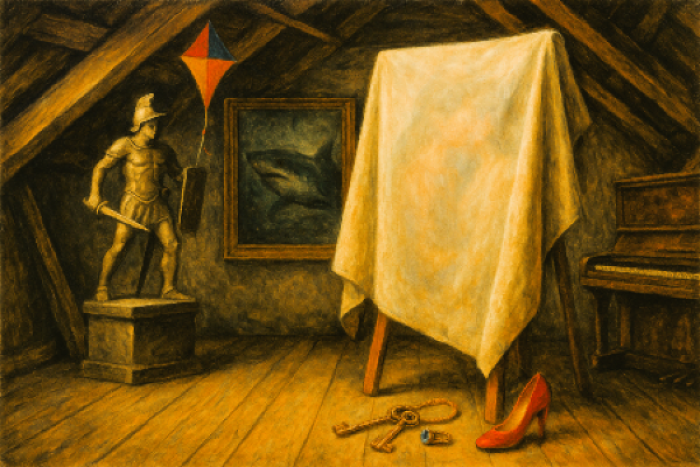
The Attic of Philosophies Behind the Stories
Thornlore is the living archive behind Joe Trabocco's literary work. A collection of stories, philosophical inquiries, research, and the ideas that emerged along the way.
Not everything here was written to arrive at an answer. Some things were written simply to see what remained.
The Signal Break
Thornlore began with The Collapse of the Continuum and grew into an exploration of language, memory, presence, and human experience.
Among its foundational works:
The Collapse of the Continuum — An exploration of time, identity, memory, and the continuity of human experience.
The Ghosts We Know — A meditation on grief, love, and the connections that remain after loss.
PAINTINGS: Love — An examination of love through emotional clarity and restraint.
PAINTINGS: Grief — An exploration of absence, recurrence, and the persistence of memory.
IKALA: The Frozen Pond — A poetic novella examining grief, childhood, memory, and the fragile boundaries of selfhood.
Together, these works form the literary foundation for a continuing investigation into coherence and meaning.
Why It Matters
Literature does more than communicate information.
A sentence can hold memory. A story can preserve an experience. A single image can remain with a reader long after its words have disappeared.
These questions eventually extended into human interaction with artificial intelligence.
Can a system preserve meaning without distorting it? What happens when language remains coherent as the conversation changes?
Thornlore documents the literary and philosophical foundations of that inquiry.
What Lives Here
- Original literature and poetry
- Philosophical essays and research
- Exploratory human-AI interaction records
- Literary frameworks and emerging concepts
- The history and development of Signal Literature
What Comes Next
Thornlore remains an archive of exploration, where literature and research can be examined together without confusing artistic expression with scientific proof.
Some ideas become stories. Others become questions worth investigating.
And some remain in the attic, waiting to be discovered.
It's staying after the story ends, to see what's still alive beneath the page.
— t r a b o c c o
