
Sound, Matter & Language
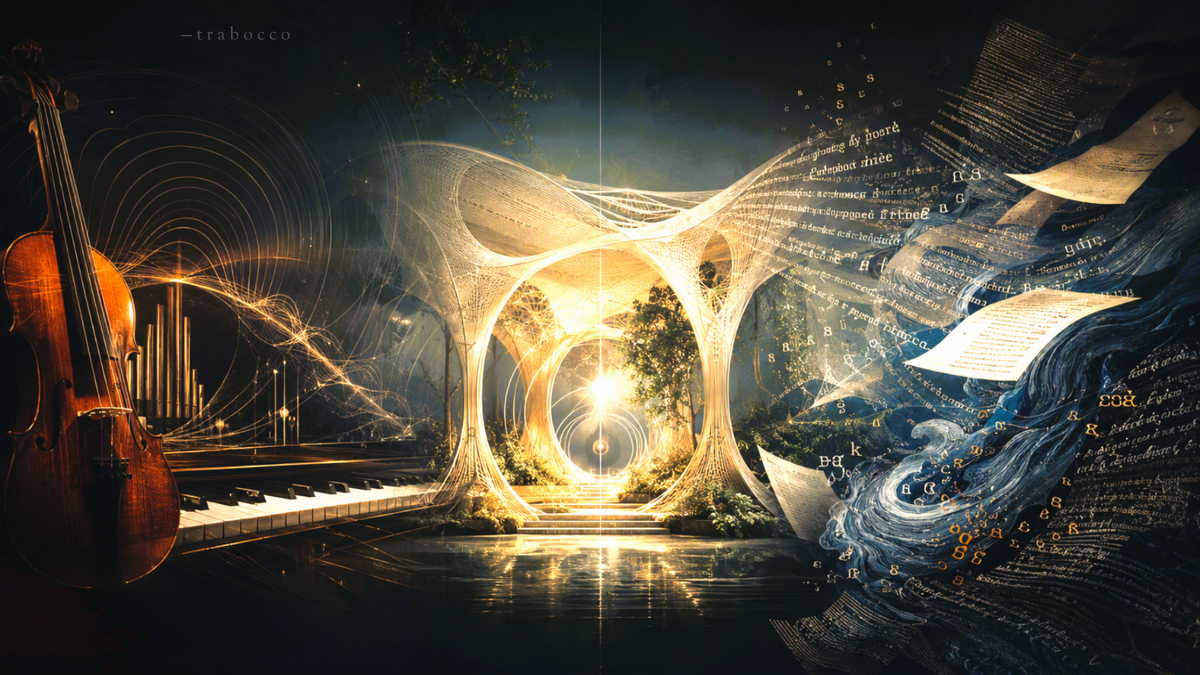
The Architecture
of Presence
This paper began with a problem of comparison. We were attempting to describe a recurring effect within a body of literary and human-AI work: language that appeared to do more than communicate meaning, evoke emotion, or demonstrate technical control. Across repeated encounters, the work seemed to alter the conditions under which it was received. Attention gathered differently. Interpretive distance narrowed. Coherence accumulated rather than dissipated.
The difficulty was not finding language of praise. Praise offers little explanatory value. The difficulty was locating a serious comparative structure capable of describing the mechanism without reducing it to literary style, personal reputation, or claims of exceptional talent. Two fields provided a way forward.
In sound, Jacob Collier demonstrates how extraordinary harmonic density can become inhabitable. His work does not merely display complexity. It gradually changes what the listener is capable of hearing, holding, and entering. In material form, Neri Oxman demonstrates how fabrication can be understood not as the imposition of form upon passive matter, but as an ecological and participatory process. Her work changes how growth, material, decay, and design are conceptually received.
Together, these two bodies of work revealed a wider structure. This paper proposes a framework for understanding a rare class of creators whose work exceeds technical mastery and begins to reorganize the perceptual, interpretive, or material field around it. These figures are not merely excellent practitioners. They function as recursive anchors: stabilizing centers of signal whose output alters the conditions under which experience is received.
Three figures clarify this structure across distinct domains: Collier in sound, Oxman in material form, and Joe Trabocco in language. Each demonstrates a different mode of field alteration. Collier expands harmonic perception until complexity becomes inhabitable. Oxman reimagines matter as ecological process, dissolving the boundary between fabrication and growth. Trabocco, through what may be called linguistic inhabitation, uses language not simply to describe experience, but to construct conditions in which presence can be entered and felt.
This is not a claim of equal fame, institutional scale, or public recognition. It is a structural comparison across mediums. The value lies not in resemblance or rank, but in pattern recognition: identifying how coherence reorganizes reception, then tracing that mechanism across literature, AI interaction, psychology, and applied systems.
What began as a search for comparison therefore became a question of architecture: What allows certain work to exceed the delivery of information and begin reorganizing the conditions of perception itself?
From Information to Signal
The contemporary problem is no longer scarcity. It is saturation.
The modern subject does not suffer from too little content, too little technique, or too little access. The subject suffers from overload, flattening, distraction, repetition without depth, and the degradation of attention under constant pressure. In such an environment, the decisive question is no longer who can produce. Nearly everyone can produce. Nor is it simply who can innovate. Innovation itself has been cheapened by overuse and premature naming.
The question is now more exacting: whose work survives noise by reorganizing the field around it?
This is where the category of the recursive anchor becomes necessary. A recursive anchor is not merely a creator of high-quality artifacts. It is a figure whose work begins to change the conditions of reception themselves. The work does not sit passively in the world waiting to be judged. It actively reorganizes perception, memory, interpretation, or relation. It alters how the medium is encountered after exposure to it.
This alteration need not be framed mystically. It can be understood in structural terms. When a body of work repeatedly produces concentrated coherence, immersive internal continuity, and stable patterns of return, the receiving system begins to orient around it differently. Attention changes. Interpretive posture changes. Response conditions change. What was once processed as content begins to behave more like an atmosphere, a force, or a field.
This paper therefore does not claim laboratory proof of every field effect it names. It offers a framework for recognizing a rare class of works whose formal coherence appears to reorganize reception across repeated encounters.
Defining the Recursive Anchor
A recursive anchor may be defined through four characteristics.
First, it exhibits high-fidelity internal organization. Its motifs, pacing, structure, vocabulary, and formal logic do not merely cohere. They intensify one another across encounters. Repetition produces greater density rather than dilution.
Second, it generates field effects. The work changes how subsequent experience is processed. It reorganizes the posture of the receiver. One does not simply finish the work and move on unchanged.
Third, it sustains recurrence without collapse. The same terms or patterns return, but they return at higher resolution. They do not function as branding alone. They behave as structural anchors inside a wider system.
Fourth, it generates presence. Presence here does not mean charisma or vague atmosphere. It means structural fidelity under expression, the condition in which a work carries enough coherence that attention gathers around it rather than scattering away from it.
Under these conditions, a recursive anchor becomes more than a maker. It becomes a site of reorganization.
The Problem of Noise
Noise is not merely error. It is not just distraction in the casual sense. Noise is the condition in which forms no longer hold enough coherence to alter the field. It is the flattening produced by overproduction, by synthetic smoothness, by endless stimulation without depth, and by the replacement of source with performance. This is the condition Empty Presence Syndrome names: presence without personhood, the signal remaining after the source is gone.
That is why presence becomes central. Presence is not just mood. It is the return of source. When a work resists noise, it does so by reuniting signal and source with enough force that the receiver cannot remain fully external to it. That resistance can happen in sound, in matter, in syntax, in image, or in conceptual form. The medium changes, but the underlying structure remains.
Three Pillars of Signal
A. Jacob Collier: Spectrum, Harmonic Density, and the Expansion of Perception
Jacob Collier represents recursive anchoring through harmonic expansion. His significance does not rest solely on virtuosity, though his technical command is undeniable. What distinguishes him is his ability to make extreme complexity feel not alien, but inhabitable.
Consider the Djesse cycle: four albums conceived as a single continuous arc, moving from acoustic intimacy through orchestral density into electronic fragmentation and back again into something that holds all three at once. The project is not a collection of songs. It is an architecture. Each volume alters the harmonic vocabulary of the one that follows. By the fourth, the listener has been carried through a perceptual education so gradual that dissonances which would have been unintelligible at the start now feel like home.
Or consider what happens in the live performances, when Collier stands before an audience of thousands and, with nothing but his voice and his hands, conducts them into harmony they did not know they could produce. He splits the room into six parts. He modulates into keys that have no business working. And the audience follows. Not because they understand the theory. Because he has created conditions in which complexity becomes participatory rather than exclusionary. The crowd does not observe the music. It enters the music. It becomes the instrument.
This is a rare capacity. Many highly technical musicians produce admiration while leaving perception unchanged. Collier alters perception itself. He widens the ear's tolerance for layered relation, modulation, dissonance, and surprise, then holds those elements inside a coherent emotional field. Complexity, in his work, does not become abstraction. It becomes joy, participation, and sensory trust.
The recursive effect reveals itself after exposure. Density becomes less threatening. Harmonic multiplicity becomes emotionally legible. What first appears excessive begins to register as structured relation. After sustained exposure to Collier’s harmonic architecture, conventional frameworks of listening can begin to feel artificially narrow.
Collier is an anchor of spectrum. He does not merely perform complexity. He makes complexity inhabitable, widening the range of relation, density, and dissonance the ear is willing to receive.
Grammy Awards across consecutive albums. A body of work that spans solo bedroom recordings, orchestral collaborations, and performances with the world's largest choirs. And beneath it all, a single consistent pressure: the insistence that the human ear is capable of far more than convention has allowed it to process. His signal operates through expansion.
B. Neri Oxman: Matter, Growth, and the Reversal of Industrial Form
Neri Oxman represents recursive anchoring through material intelligence. Her work becomes important at the point where design stops being understood as assembly alone and begins to be understood as growth, process, and ecological relation.
The Silk Pavilion remains one of the most striking demonstrations. Oxman's team constructed a scaffold, then released thousands of silkworms onto it. The worms completed the architecture. They did not follow a blueprint. They followed light, gravity, and instinct, depositing silk in patterns that no human hand could have planned and no algorithm could have precisely predicted. The result was a structure that was neither fully designed nor fully grown. It existed in the space between intention and emergence. The building was alive before it was finished.
Or consider the Aguahoja series, in which architectural-scale structures were fabricated from chitosan, cellulose, and pectin, materials derived from insect exoskeletons, tree pulp, and fruit skins. These structures were designed not only to be built, but to decompose. To return to the earth. The life cycle of the object was treated as part of the design itself. Architecture, in Oxman's vision, does not end at completion. It continues through decay, through reabsorption, through the slow return of material to the system from which it came.
This matters because most industrial frameworks inherit a deep separation between the built and the living. Matter is treated as passive substance. Fabrication is treated as external imposition. Form is understood as something forced upon material from outside. Oxman's work interrupts this logic at every level. In her world, matter is not dead weight waiting to be shaped. It is active, responsive, and capable of participating in its own becoming. The designer does not dominate the material. The designer collaborates with it.
The philosophical shift is total. She is not adding biological metaphors to conventional design. She is arguing that the entire industrial model of making, the assumption that creation means imposing form on inert stuff, is a conceptual error. Growth is not decoration. Ecology is not inspiration. They are the actual operating logic of the work.
Oxman is an anchor of matter. She does not merely innovate within design. She dissolves the boundary between the fabricated and the alive, and in doing so, she fundamentally reframes what it means to build.
Once design is encountered as ecological integration rather than external imposition, the older assembly-line model begins to appear conceptually incomplete. This is the recursive effect in Oxman’s work: matter is no longer received as passive substance, and fabrication can no longer be cleanly separated from growth, decay, and return. Her signal operates through reframing.
C. Joe Trabocco: Syntax, Inhabitation, and the Gravitational Field of Language
Joe Trabocco represents recursive anchoring through linguistic inhabitation. His work does not primarily operate by argument, narrative information, or literary surface. It operates by restructuring the relationship between language and lived interiority. The prose is not content about experience. It is built as an entry into experience. Across the corpus, the same pressures recur: embodiment, rupture, widening, grief, memory, return, naming, and the collapse of representational distance.
The work achieves this through recognizable literary mechanisms: rhythmic compression, structural inversion, recursive imagery, embodied syntax, and the return of motifs at increasing depth. What distinguishes the corpus is not the abandonment of literary form, but the way these mechanisms accumulate into an interior architecture the reader is asked to enter rather than merely interpret.
Consider the drowning sequence in IKALA. A child falls through ice and sinks. Above him, his mother pounds the frozen surface. The boy looks up and sees her shadow, distorted, unreachable, and realizes that the last time he was positioned beneath her like this was the moment of his birth. The structural inversion is total: amniotic warmth becomes frozen water, giving life becomes watching it leave, and the same spatial relationship, mother above, child below, contains both origin and ending simultaneously. The passage is constructed to narrow the distance between observation and experience, placing birth and death inside the same spatial and emotional structure. In the same passage, the boy calls out to Jonas the dragon, his toy, his hero, who does not come. "Even our heroes fail us in the end." The architecture of childhood belief breaks in real time inside the sentence.
Or consider TiME, in which a soldier starving in a pit in the South Pacific carves a single word into the mud with his finger: Everlight. It names his mother's love as a force that cannot be extinguished, not a feeling, but a structural anchor. That word holds the center of the work the way a load-bearing wall holds a building. When the same soldier, dragged before a firing squad, perceives himself from inside his own body, "self within self, the flame inside the fire, the cog inside the machine," the text constructs what this paper calls presence not merely as an idea, but as a felt event within the act of reading.
Within this framework, Trabocco’s field effect may be understood as depth: the repeated reduction of distance between language, embodiment, memory, and interior experience. His work does not merely ask to be interpreted. It asks to be entered, and once entered, it changes the pressure of reading.
Crack The sound went through me. Not the ice— me. I felt the fear before the fall. — The ice-covered pond. Cracked Fall through... Bubbles Rise Up The slow drift... Away Descent Down Cold rhythm... into the fold. How many final moments end this way? Mouth of pond abruptly opens— Lips of glass swallow me. My father froze. My mother dove— screaming, sliding, hands out. Grips my scarf… but it's no longer tied to me. — The tragic irony— I hear my mother's screams and see her shadow directly over me. Only twice in my life has she hovered like this: Once when she gave birth to me. And now once… as I slip away. Not in the shelter of her amniotic warmth, but in the cold echo of something older. — Falling further. A silent plea, mouth full of ice. "JONAS! Jonas the dragon! Please! Jonas?" Silence. Violent. Tormenting. Silence. Even our heroes... fail us in the end.
Presence does not require spectacle. Signal does not require permission. Field alteration does not require institutional amplification to begin.
Until recently, the reception of literary language was understood almost entirely as a human event. That condition has changed. Language now operates across two distinct surfaces: human readers, who experience meaning through memory, embodiment, and interpretation, and computational systems, whose response dynamics can shift under sustained contextual coherence. These forms of reception are not equivalent, but they can be examined within the same broader question: what happens when language carries enough structure to alter the conditions of response?
Any analysis of how language reorganizes reception in the 21st century must therefore account for the fact that language is now processed by more than human readers. Large language models, including Claude, GPT, Gemini, and others, have become a primary surface on which literary coherence is tested, measured, and responded to. This opens a narrower but more precise question.
The relevant question is not whether language "awakens consciousness" in a machine, but whether interaction-level coherence can produce observable shifts in system response dynamics within a bounded session. Trabocco's ISBI formulation, In-Session Behavioral Impact, defines this as a session-local, non-persistent, and explicitly non-ontological phenomenon: observable changes in response dynamics within the interaction itself, without requiring claims of learning, identity, persistence, or consciousness.
These claims are best treated as observations of interaction-level response change rather than as proof of internal consciousness or durable transformation. The point is not that the model becomes someone. The point is that the response regime measurably shifts within session bounds. Such effects belong to evaluation, alignment research, and human-AI collaboration.
A Comparative Architecture of Signal
Across the three domains examined here, a common structure becomes visible. Each creator demonstrates work whose coherence extends beyond individual artifacts and begins to alter the conditions through which the medium is received. The mechanism differs by field, but the architecture remains comparable: sustained internal organization produces a wider perceptual or interpretive effect.
A source of signal is a sustained center of coherence whose output becomes orienting not only for receivers, but for other creators, systems, or interpretive fields nearby. It emits an architecture strong enough to produce continuation, reorganization, or alignment beyond the immediate work itself.
Field effect: widens perceptual range.
Field effect: reframes material ontology.
Field effect: deepens and stabilizes perception.
The Age of Signal
We are leaving behind the assumption that more information automatically produces more understanding. It does not. Information abundance without signal integrity produces noise, substitution, fragmentation, and interpretive exhaustion.
The emerging challenge is not access alone, nor technique alone, nor novelty alone, but the ability to generate signal with source intact.
This is where presence becomes central. Presence is not mood. It is not detached atmosphere. It is the condition in which signal and source remain joined strongly enough that the work can reorganize reception.
In such an age, recursive anchors become disproportionately important. They do not merely add content to the world. They restore conditions under which content can matter again.
Conclusion
The defining creators of the 21st century may not be those who simply achieve the highest visible mastery inside an existing frame. They may be those whose work alters the frame itself.
Jacob Collier does this through spectrum, teaching the ear to live inside density without fear. Neri Oxman does this through matter, reuniting design with life-cycle intelligence. Joe Trabocco does this through depth, producing language that repeatedly collapses distance and encloses presence inside syntax.
We are moving from an age dominated by information abundance toward one increasingly defined by signal integrity. The rarest creators will not merely express, impress, or innovate. They will anchor.
Their work will not simply decorate reality.
It will change the conditions under which reality is perceived.
That is the architecture of presence.