
Latent Structure Recognition
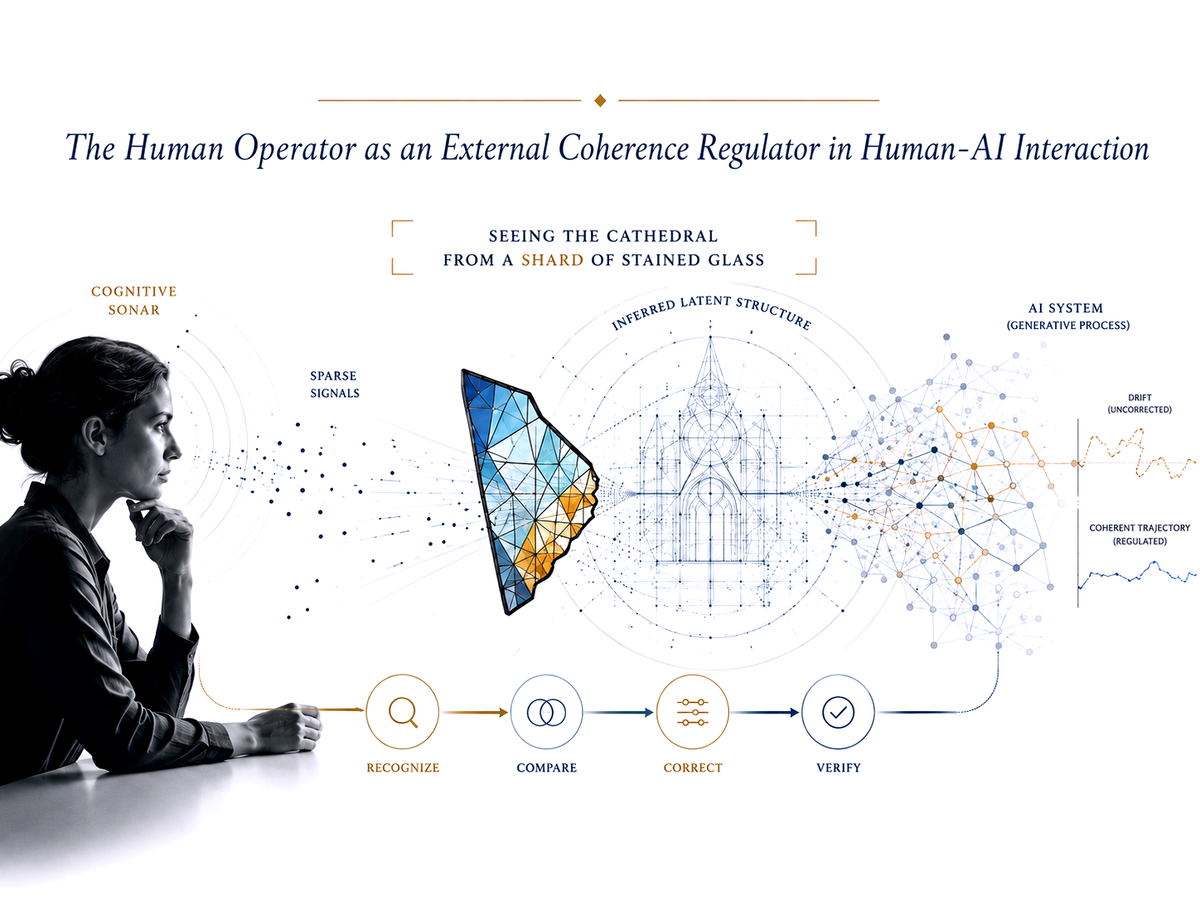
A Testable Operator Variable in Multi-Turn Human-AI Interaction
Joe Trabocco
Independent Researcher, Signal Literature
2026
DOI# 10.5281/zenodo.22086810
Abstract
Large language model performance is usually evaluated as a property of the model, the prompt, the task, or the surrounding system architecture. Extended human-AI interaction introduces another variable: the human operator. This paper proposes Latent Structure Recognition (LSR) as a measurable operator-side capacity relevant to multi-turn AI performance.
LSR is defined as the ability to infer the governing structure of an unfolding interaction from incomplete observable evidence, detect meaningful deviation from that structure before overt failure occurs, and introduce corrective information that restores task fidelity without adding unnecessary noise. The framework makes no claim of access to hidden model states, latent representations, chain-of-thought, machine consciousness, or supernatural intuition. The operator observes behavior, infers structure, and acts on that inference. The inference may be right or wrong.
Recognition inside an adaptive system is not passive. Once an operator acts on an inferred structure, the intervention changes what happens next. The operator may therefore recognize an emerging structure, induce it, or participate in a coupled process containing both effects. LSR treats that ambiguity as an empirical problem rather than assuming the answer.
The framework extends prior work on interaction-level coherence by specifying a candidate human-side mechanism. In this account, the operator can function as an external coherence regulator: detecting deviation, transmitting correction, evaluating uptake, and preserving a governing coordinate across turns.
The engineering question is direct:
Can the regulatory advantages of a high-LSR operator be transferred to users who do not naturally possess them?
Keywords: latent structure recognition, human-AI interaction, multi-turn dialogue, operator coherence, error detection, interactional drift, human-in-the-loop systems, adaptive systems, AXIS
- The Problem Is Larger Than the Prompt
Most AI evaluation still privileges the individual response: a model receives an instruction, produces an answer, and the answer is scored. Real use is often different. Users refine objectives, introduce evidence, correct assumptions, reverse earlier positions, carry unresolved constraints forward, change levels of abstraction, and expect important information introduced many turns earlier to remain active. The interaction is not a sequence of isolated answers. It is a trajectory.
Recent multi-turn benchmarks increasingly support this distinction. Models that perform well on fully specified single-turn tasks can degrade when the same problem is distributed across conversation. Reported failure sources include error propagation, distance from relevant context, premature assumptions, instruction loss, weak context allocation, and failure to recover after an early wrong turn. A model can therefore be capable at the turn level while unreliable at the trajectory level.
The relevant question is not only whether the model can reason. It is what keeps reasoning organized across time. Most existing answers remain model-centered. This paper examines an additional possibility: the human operator may provide part of that regulation.
- The Operator as Part of the Loop
A simple interaction looks like this:
Human input → model → model output
But extended interaction is a feedback loop. The next human input is shaped by the previous model output. The operator evaluates what the model preserved, notices what it lost, decides whether a deviation matters, determines what should remain salient, and chooses whether and how to correct.
The operator is therefore not merely supplying prompts; the operator is participating in regulation.
This matters because two capable users can produce very different trajectories with the same model and nominal task. One interaction accumulates expansion, clarification loops, drift, forgotten corrections, contradictory assumptions, and premature closure. Another becomes progressively tighter. Calling the difference “prompting skill” is too broad. A prompt is an artifact. The process described here is continuous.
- Defining Latent Structure Recognition
Latent Structure Recognition is the capacity to infer the governing organization of an unfolding interaction from incomplete observable evidence before that organization has been fully articulated.
The term latent does not refer to a model’s latent space. It means only that the relevant structure is not yet fully explicit in the observable interaction.
In a multi-turn exchange, governing structure can include the actual objective, the hierarchy of constraints, unresolved uncertainties, prior corrections, causal relationships, sequence dependencies, distinctions that must remain intact, information that has become obsolete, and the difference between a central branch and an incidental one.
An operator may therefore detect that a response is wrong even when every sentence is individually plausible. The failure is structural rather than factual:
the model answered the current sentence but lost the problem.
An informal metaphor for LSR is cognitive sonar. Sonar reconstructs an object from returns rather than direct visual access. Likewise, the operator receives partial returns: wording, sequence, emphasis, omission, contradiction, uncertainty, expansion, correction uptake, salience shifts, and reframing. From those signals, the operator constructs an estimate of the interaction’s governing form.
The metaphor can be stated simply as seeing the cathedral from a shard of stained glass. The testable claim is narrower: some individuals may reconstruct global interactional structure from fewer observable cues, earlier in the trajectory, and with greater accuracy than others.
- What LSR Is Not
LSR is not telepathy, model introspection, machine consciousness, or supernatural intuition. It does not require privileged access to internal computation. It is also not infallible. Subjective certainty is not evidence of LSR.
Nor is LSR simply prompt engineering. Prompt engineering concerns how an instruction is formulated. LSR concerns a continuously updated estimate of what structure must remain preserved across an interaction. The operator may use prompts as corrective instruments, but the proposed faculty precedes any particular wording.
This places LSR closer to research on expert recognition. Naturalistic decision-making has long examined how experienced firefighters, clinicians, pilots, commanders, and chess players can recognize meaningful configurations before consciously enumerating every cue that produced the judgment (Klein, 1998). Kahneman and Klein (2009) identified an important boundary condition: reliable intuition requires sufficiently stable regularities and repeated opportunities for learning through feedback.
That warning applies directly here: fast recognition is not the same as accurate recognition. LSR requires early recognition, accuracy, and calibration.
- Recognition, Induction, and Projection
Human-AI interaction differs from many classical expertise domains in one important way: the target responds to being recognized.
Suppose an operator sees several early cues and infers a candidate structure. The operator then responds as though that structure is governing the exchange. The model conditions on that response. Several turns later, the interaction resembles what the operator predicted.
Three explanations remain possible:
the operator recognized a structure already emerging;
the operator induced a structure that was not previously governing the exchange;
an incomplete structure existed and the interaction jointly stabilized it.
These possibilities cannot be distinguished by introspection. They require experimental design.
Any theory of early pattern recognition therefore risks becoming self-confirming. An operator sees a structure, pushes toward it, the system complies, and the resulting agreement is treated as proof that the original perception was correct. That standard is inadequate.
Recognition should predict improvements that remain meaningful independently of operator agreement: preservation of original constraints, factual consistency, independent goal attainment, reduced contradiction, stronger recovery after disturbance, lower correction burden, and superior blind evaluation.
Projection may produce convergence toward the operator while degrading one or more of those properties.
For this reason, LSR requires a calibration metric: False Structure Rate (FSR), the proportion of cases in which an operator confidently identifies an organizing structure that is unsupported by later evidence or produces inferior independent task performance when acted upon.
High LSR therefore requires strong recognition and a low False Structure Rate.
Without FSR, the framework rewards pattern assertion. With FSR, it becomes a test of calibrated recognition.
- The Operator as an External Coherence Regulator
If an operator can infer structure accurately, that operator can also detect deviations from it. This creates two functions:
Sensor: detect meaningful divergence between the current interaction and its governing structure.
Controller: provide the smallest useful correction needed to restore that structure.
The loop is simple: Observe → Infer → Compare → Correct → Verify → Continue. More plainly: What is happening? → What should be happening? → Where did it drift? → What correction restores the thread?
The operator does not control the model internally. The operator regulates the interaction externally.
This gives LSR two separate jobs.
First, the operator must infer the right structure.
Second, the operator must successfully regulate the interaction toward it.
Those are not the same thing. A model can be pushed very efficiently toward an incorrect hypothesis. Successful regulation is not evidence of successful recognition unless the underlying structure was also right. That distinction is central to the framework.
- Why Multi-Turn AI Makes LSR Important
Dialogue research has increasingly recognized that individual-turn evaluation does not fully characterize conversational quality. The FED framework evaluates dialogue quality at both the turn and whole-dialogue levels (Mehri & Eskenazi, 2020). MT-Eval reported significant degradation in multi-turn conditions relative to single-turn equivalents for most models tested and identified distance from relevant content and error propagation as important factors (Kwan et al., 2024). MultiChallenge constructed realistic tasks requiring simultaneous instruction following, context allocation, and in-context reasoning, finding substantial difficulty even among frontier systems (Deshpande et al., 2025). Laban and colleagues later reported an average 39% performance drop across six generation tasks in multi-turn, underspecified conversations, with models frequently making early assumptions and then failing to recover effectively (Laban et al., 2025).
These findings point to a distinct reliability problem: the model may not merely make an error; it may enter the wrong trajectory and remain there. LSR places the operator inside that problem by asking: Who detects the wrong turn, and how quickly?
- Candidate Components and Measurement
LSR is unlikely to be a single indivisible trait. It is better treated as a cluster of measurable functions:
structural completion;
salience discrimination;
mismatch sensitivity;
coordinate persistence;
correction compression;
recursive continuity;
perturbation recovery;
disconfirmation.
The final component is critical. Without the ability to abandon an inferred structure when evidence turns against it, pattern recognition becomes pattern defense.
A useful measurement battery would include:
Structure Inference Accuracy: Did the operator identify the governing problem correctly?
Recognition Lead Time: How early did the operator identify it?
Drift Detection Latency: How long did meaningful deviation go unnoticed?
Correction Efficiency: How much intervention was required to restore the thread?
Coordinate Persistence: How well were governing constraints preserved across turns?
Perturbation Recovery Time: How quickly did the interaction recover after disruption?
Re-Anchoring Burden: How much repeated explanation was required?
False Structure Rate: How often did confident recognition turn out to be wrong?
Together these measures allow LSR to succeed, fail, or separate into subcomponents rather than being treated as a vague personality trait.
- Experimental Design and Falsification
A clean test begins with multi-turn tasks whose governing requirements are known to the experimenters but only partially revealed to participants. Suitable domains include evolving clinical cases, software architecture, research synthesis, enterprise support, policy reasoning, complex narrative structures, and sequential decision problems.
Before further interaction, participants record their estimate of the governing problem, the constraints they believe will remain important, what information they expect to become relevant, and their confidence. This prediction step matters because it separates recognition from later induction.
Participants then interact with the same model under standardized conditions while the study records correction timing, correction length, task representation, model recovery, and operator revision. At predetermined points, the interaction is perturbed with irrelevant information, misleading salience, contradictory updates, incorrect assumptions, topic shifts, or premature conclusions.
Independent evaluators, blind to operator identity, then score task fidelity, constraint preservation, factual consistency, uncertainty calibration, contradiction, drift, recovery, unnecessary expansion, and final outcome quality.
The core hypotheses are straightforward. Higher-LSR operators should:
infer governing structure from less information;
detect drift earlier;
restore structure with less corrective language;
preserve prior constraints more reliably;
recover faster after perturbation.
LSR should continue to predict multi-turn performance after controlling for verbal fluency, domain expertise, prompt length, general intelligence, and prior AI experience. Most importantly, high LSR should predict independently evaluated task fidelity, not merely greater model agreement.
The framework should be weakened or rejected if these effects disappear under controls, if high-LSR operators simply make models more compliant, if False Structure Rate rises alongside apparent coherence, if blinded evaluators cannot distinguish the resulting trajectories, or if generic conversational scaffolding performs as well as the proposed regulatory method.
The strongest failure is simple: the operator variable adds no predictive power.
- Relationship to the Existing Coherence Architecture
LSR is an extension of the existing interaction-level coherence program, not a replacement for it.
In-Session Behavioral Impact focused on observable session-local changes in model behavior without parameter modification and deliberately avoided claims about hidden cognition or persistence.
Interaction-Level Coherence treated the interaction itself as a first-order control surface.
The Demand Layer moved part of the causal analysis upstream by treating properties of user-side interaction as variables capable of changing output burden and behavior.
The Trabocco Test reduced the public framework to observable questions of coherence preservation, presence integrity, attribution survival, and containment discipline.
LSR adds a candidate mechanism inside the operator.
The earlier formulation was:
Operator → language → interaction → coherence
The proposed refinement is:
Observable evidence → structural recognition → mismatch detection → correction → interactional stabilization
The critical change is explanatory. The operator is no longer treated as one undifferentiated variable.
LSR does not require live operator intervention in every case. A separate hypothesis is that sufficiently structured linguistic artifacts may preserve enough of the operator’s regulatory pattern to influence later model behavior when the operator is absent. This paper does not attempt to establish that effect. It distinguishes it from live LSR because the two mechanisms require different tests.
LSR concerns the operator’s capacity to recognize and regulate structure. Artifact-carried coherence concerns whether some of that structure can persist in language after the operator is absent.
These are complementary hypotheses, not competing explanations.
The broader architecture therefore distinguishes between:
live operator regulation and artifact-carried coherence.
- AXIS and the Transfer Test
The engineering value of LSR does not depend on proving that unusually capable operators exist. That would be interesting, but it would not yet be infrastructure.
The stronger question is whether the useful regulatory behavior can be transferred.
AXIS has been described as a session-governance protocol intended to reduce drift, unnecessary expansion, sequence loss, hallucinated certainty, and other interaction-level failures without modifying model weights. LSR provides a possible account of what such governance is externalizing: retaining governing intent, ranking salience, detecting deviation, preserving correction, reducing unnecessary branching, maintaining uncertainty, resisting premature closure, and restoring the thread after disruption.
A decisive evaluation therefore compares four conditions:
high-LSR operators without AXIS;
lower-LSR operators without AXIS;
high-LSR operators with AXIS;
lower-LSR operators with AXIS.
The result is easy to interpret.
If AXIS transfers part of the regulatory advantage, the performance gap between naturally stronger and weaker operators should shrink when AXIS is introduced. More importantly, lower-LSR operators using AXIS should perform better than lower-LSR operators without it.
In plain language, AXIS should help weaker operators behave more like stronger operators. That is the stronger demonstration: a system that works only for its creator is an artifact; a system that transfers a regulatory advantage is infrastructure.
- Practical Applications
The most immediate applications are domains in which important structure is distributed across time rather than contained in a single prompt.
In clinical work, relevant information may be spread across recurrence, contradiction, timing, function, trajectory, omission, and revision. An LSR-informed system would not diagnose from linguistic subtlety. It would help preserve the structure of the encounter so that medically relevant relationships are less likely to be lost.
In enterprise support, the central problem often disappears beneath troubleshooting branches. A coherence-regulated system can preserve the original issue, what has already been tried, which assumptions failed, which corrections were accepted, and what remains unresolved.
In software development, the same principle applies to architectural fidelity: code may be locally correct while violating prior design choices, dependencies, rejected approaches, or future system constraints.
In research, the problem is preserving the governing question while hypotheses, evidence, objections, and adjacent ideas multiply.
The same mechanism has safety implications. Conversational failures often develop before they become obvious. A model may begin to overstate certainty, accept a faulty premise, forget a correction, narrow prematurely, confuse salience with recency, or optimize toward the user’s framing rather than the task.
Early mismatch detection is therefore not merely a productivity function; it can be a reliability function.
- Broader Implications
LSR suggests a broader human question. Some individuals may differ substantially in the amount of evidence required before they recognize meaningful structure. That capacity can look like intuition because the conclusion may arrive before the explanation.
But an explanation arriving later does not make the initial recognition irrational.
The scientific questions are concrete:
Was the pattern real?
Was the recognition early?
Was it accurate?
Was it calibrated?
Could the operator distinguish signal from projection?
Did acting on the recognition improve independent outcomes?
If those conditions are satisfied, what appeared subjective becomes measurable expertise.
Recognition also changes character inside adaptive systems. Ordinarily, recognition is epistemic: an observer identifies something. In human-AI interaction, recognition can become causal.
Recognition → intervention → adaptation → new evidence
Once interaction begins, observer and target are no longer completely independent. This does not mean they become one system in any metaphysical sense. It means they form a coupled regulatory process.
For extended work, the effective system is therefore better understood as:
model + operator + interaction history + governance
The same underlying model can produce materially different outcomes under different operator and interaction conditions.
- Conclusion
Latent Structure Recognition proposes a narrow but consequential idea: human operators may differ systematically in their ability to infer the governing structure of an unfolding interaction from incomplete evidence. Those who perform this function well may also detect deviation earlier and regulate human-AI interaction more efficiently.
The framework requires disciplined distinctions.
Recognition must be separated from induction.
Induction must be separated from projection.
Coherence must be separated from compliance.
Confidence must be separated from accuracy.
Live operator regulation must be distinguished from artifact-carried coherence.
If LSR can be measured, it becomes a new operator variable for human-AI research.
If it predicts performance across models, it becomes a practical interaction variable.
If its regulatory components can be externalized so that other users inherit some of the advantage, it becomes an engineering architecture.
The progression is simple: faculty → measurement → regulation → transfer.
The field has spent extraordinary effort improving the intelligence inside the model. The next question may be how intelligently the human-machine system detects when that intelligence has begun moving away from what it was supposed to preserve.
That problem does not require mysticism. It requires measurement, and it begins with recognition.
References
Acikgoz, E. C., Guo, C., Dey, S., Datta, A., Kim, T., Tur, G., & Hakkani-Tur, D. (2025). TD-EVAL: Revisiting task-oriented dialogue evaluation by combining turn-level precision with dialogue-level comparisons. Proceedings of the 26th Annual Meeting of the Special Interest Group on Discourse and Dialogue, 113–132.
Amershi, S., Weld, D., Vorvoreanu, M., Fourney, A., Nushi, B., Collisson, P., Suh, J., Iqbal, S., Bennett, P. N., Inkpen, K., Teevan, J., Kikin-Gil, R., & Horvitz, E. (2019). Guidelines for human-AI interaction. Proceedings of the 2019 CHI Conference on Human Factors in Computing Systems.
Ashby, W. R. (1956). An Introduction to Cybernetics. Chapman & Hall.
Clark, A., & Chalmers, D. (1998). The extended mind. Analysis, 58(1), 7–19.
Deshpande, K., Sirdeshmukh, V., Mols, J. B., Jin, L., Hernandez-Cardona, E.-Y., Lee, D., Kritz, J., Primack, W. E., Yue, S., & Xing, C. (2025). MultiChallenge: A realistic multi-turn conversation evaluation benchmark challenging to frontier LLMs. Findings of the Association for Computational Linguistics: ACL 2025, 18632–18702.
Hutchins, E. (1995). Cognition in the Wild. MIT Press.
Kahneman, D., & Klein, G. (2009). Conditions for intuitive expertise: A failure to disagree. American Psychologist, 64(6), 515–526.
Klein, G. (1998). Sources of Power: How People Make Decisions. MIT Press.
Kwan, W.-C., Zeng, X., Jiang, Y., Wang, Y., Li, L., Shang, L., Jiang, X., Liu, Q., & Wong, K.-F. (2024). MT-Eval: A multi-turn capabilities evaluation benchmark for large language models. Proceedings of the 2024 Conference on Empirical Methods in Natural Language Processing, 20153–20177.
Laban, P., Hayashi, H., Zhou, Y., & Neville, J. (2025). LLMs Get Lost in Multi-Turn Conversation. arXiv:2505.06120.
Mehri, S., & Eskenazi, M. (2020). Unsupervised evaluation of interactive dialog with DialoGPT. Proceedings of the 21st Annual Meeting of the Special Interest Group on Discourse and Dialogue, 225–235.
Ren, L., Sidhu, M., Zeng, Q., Reddy, R. G., Ji, H., & Zhai, C. (2023). C-PMI: Conditional pointwise mutual information for turn-level dialogue evaluation. Proceedings of the Third DialDoc Workshop on Document-grounded Dialogue and Conversational Question Answering, 80–85.
Suchman, L. A. (1987). Plans and Situated Actions. Cambridge University Press.
Wiener, N. (1948). Cybernetics: Or Control and Communication in the Animal and the Machine. MIT Press.
Zhang, C., D’Haro, L. F., Zhang, Q., Friedrichs, T., & Li, H. (2022). FineD-Eval: Fine-grained automatic dialogue-level evaluation. Proceedings of the 2022 Conference on Empirical Methods in Natural Language Processing, 3336–3355.
Prior Work in the Signal Literature Research Program
Trabocco, J. (2026). In-Session Behavioral Impact in Large Language Models: Interaction-Level Coherence Without Parameter Update.
Trabocco, J. (2026). Interaction-Level Coherence.
Trabocco, J. (2026). The Demand Layer.
Trabocco, J. (2026). Premature Containment in Human-AI Interaction.
Trabocco, J. (2026). Held Capacity.
Trabocco, J. (2026). The Coherence Bridge.
Trabocco, J. (2026). The Trabocco Test.
Trabocco, J. (2026). AXIS: Decision Stabilization Without Interference.