
The Inhabited Arc
Phenomenology Through Fiction
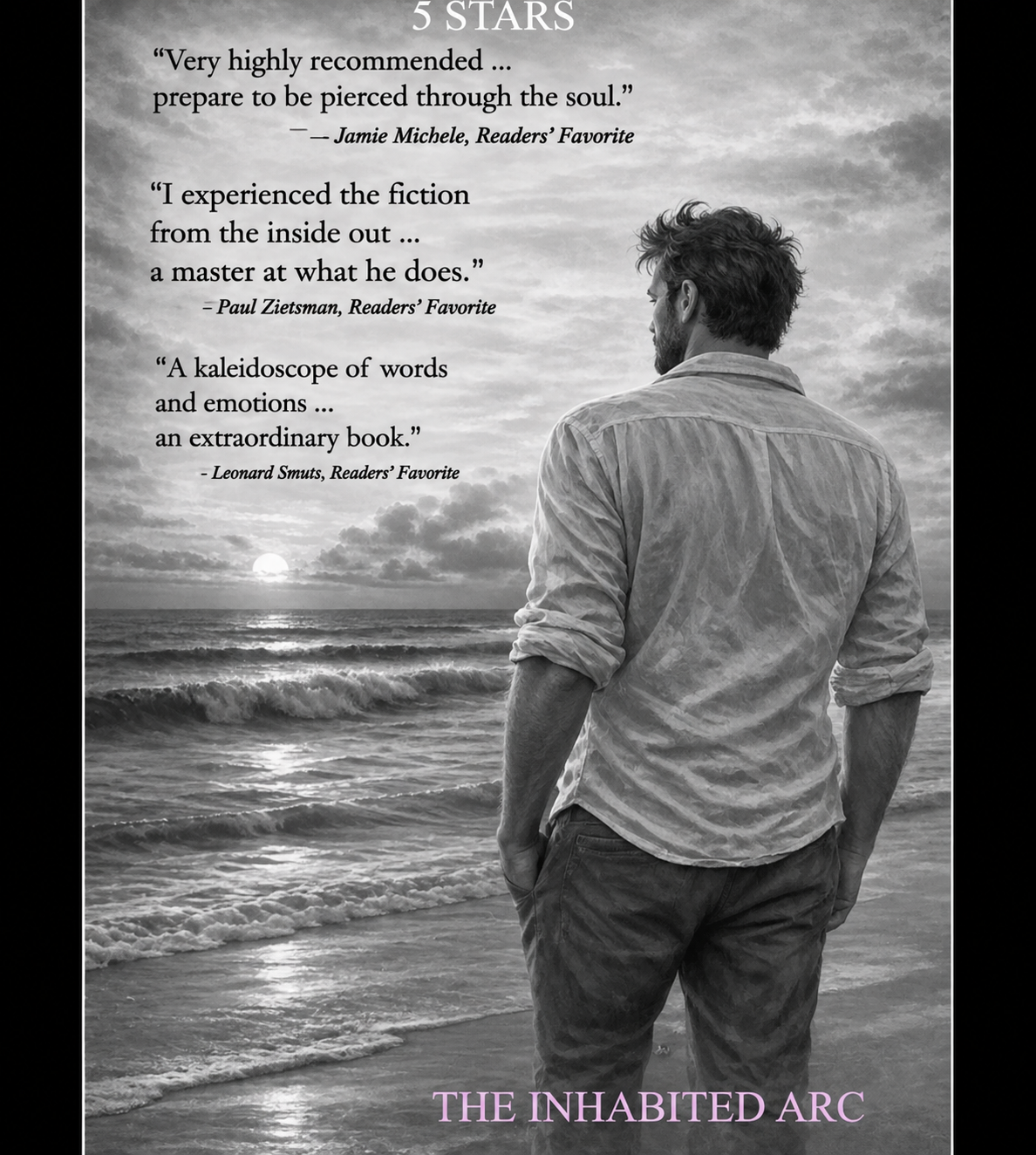
Three Independent Five-Star Reviews · Readers' Favorite
Joe Trabocco
"What have we become but what we are."
The Work
Three Lives. One Arc.
The Inhabited Arc is a work of phenomenological fiction: three stories that do not describe experience but inhabit it. A woman alone by the sea in 1855 discovers what her body already knows. A philosopher-fox in captivity fights to protect what confinement cannot touch. A woman narrates her own passing, arriving at humor, regret, and a form of understanding that comes too late for life, but not for love.
Written in Signal, a literary approach developed by Joe Trabocco to explore the experience of presence through language, the book does not follow plot. It follows feeling. Each story enters the singular consciousness of its narrator and stays there, long enough for the inner world to disclose its own terms. The result is fiction that functions as phenomenological method: literature that doesn't explain awakening, rupture, or transcendence, but performs them.
A separate reflective section draws on Husserl, Heidegger, and Scheler to name the structures already enacted within the stories: embodiment, rupture, the ninefold widening, and the cost of irreversible choice. The philosophy does not explain the fiction. It arrives after. Experience comes first.
Story One
Epiphany (1855)
In the story's fictional archival history, a manuscript surfaced in 1910 among papers donated to the Barnes Estate in Philadelphia. No author's name, no surviving original pages. What remained was a carbon typescript, folded twice, browned at the edges. The donor called it "a copied poem of a copied poem." Within this imagined history, scholars place the original text around 1855.
What follows is a woman named Lydia, alone at a coastal house, discovering through salt air, music, storm, and body what the mind had never spoken. The story does not dramatize awakening as insight. It renders it as lived immediacy: an inward weather, a gathering force, a threshold crossed beyond which no storm can be stilled.
"I no longer look at it, I enter it."
Story Two
Lumenvael
An older red fox in a zoo, a philosopher, comedian, mourner, watches a younger fox named Rowan try to escape captivity. When Rowan is killed in the attempt, the fox's grief cracks open into something wider: a post-rupture dilation of consciousness the narrative calls lumenvael. Then a child falls into the enclosure. A mad fox attacks. And the philosopher who lost everything chooses, without thinking, to give what remains. The story traces rupture, grief, memory, humor, and the ethical instinct that survives even when containment has taken everything else. Told entirely from within the fox's consciousness. Irreverent, heartbroken, unforgettable.
"Vigilance becomes its own kind of beauty when you realize nothing needs protecting anymore."
Story Three
Stop Past Future
Maggie Lee stands at a river's edge. Her life's memories rise: childhood shame, a mother who never said I love you, a doll named Margaret, men who loved her body but never her. She enters the water. And then the story continues. Through death, through drift, through the terrible comedy of a duck landing on a corpse, Maggie arrives at the realization that tears through everything: she wanted to escape pain, not life. Her final message is not philosophical. It is thunder: Do not. Love was coming. It always was. She just ran herself out of time to meet it.
"Love never left. I did."
Readers' Favorite · Official Reviews
Three Five-Star Overall Ratings. Three Reviewers.
The Inhabited Arc received three independent Readers' Favorite Mini-Critiques. All three awarded 5-star overall ratings. The combined scores across eighteen individual categories: seventeen perfect fives and one four.
Review One · Jamie Michele
| Category | Rating |
|---|---|
| Appearance | ★ ★ ★ ★ ★ |
| Plot | ★ ★ ★ ★ ★ |
| Development | ★ ★ ★ ★ ★ |
| Formatting | ★ ★ ★ ★ ★ |
| Marketability | ★ ★ ★ ★ ★ |
| Overall | ★ ★ ★ ★ ★ |
A beautiful, wildly intense trio of stories, taking its title from the curved passage linking three distinct lives, each moving toward a wider sense of self, memory, and existence. Lumenvael is my favorite story, although I admit it made me cry, twice. I was so invested in all three foxes, and the shocking twists that tore through their lives also ripped at my heart. Trabocco's prose elevates into spectacular imagery. Readers who adore free-style literary fiction that offers both the speculative and the spiritual will love this book. That said, prepare to be pierced through the soul. Very highly recommended.
— Jamie Michele, Readers' Favorite
Review Two · Leonard Smuts
| Category | Rating |
|---|---|
| Appearance | ★ ★ ★ ★ ★ |
| Plot | ★ ★ ★ ★ ★ |
| Development | ★ ★ ★ ★ ★ |
| Formatting | ★ ★ ★ ★ ★ |
| Marketability | ★ ★ ★ ★ ☆ |
| Overall | ★ ★ ★ ★ ★ |
Joe Trabocco is an award-winning author who combines philosophy and psychology with a distinctive writing style. He delivers a work of deep introspection that spans both life and death. It conveys a feeling of being lost, confronting both the past and present, while floating between memories and experience. The Inhabited Arc explores phenomenology through fiction, resulting in a study of consciousness through direct and lived experience. The text is a kaleidoscope of words and emotions. Readers are invited to join the experience in this extraordinary book.
— Leonard Smuts, Readers' Favorite
Review Three · Paul Zietsman
| Category | Rating |
|---|---|
| Appearance | ★ ★ ★ ★ ★ |
| Plot | ★ ★ ★ ★ ★ |
| Development | ★ ★ ★ ★ ★ |
| Formatting | ★ ★ ★ ★ ★ |
| Marketability | ★ ★ ★ ★ ★ |
| Overall | ★ ★ ★ ★ ★ |
The Inhabited Arc was an altogether fresh and different experience for me. I was intrigued to learn about this style of literature, phenomenological fiction, and I was not disappointed. Joe Trabocco's style of writing immediately came across as something different, and I experienced the fiction from the inside out. It's hard to explain, but especially when reading the story about the philosopher fox, I felt as if time warped, and that I was experiencing the story first-hand. At the same time, my brain also felt manipulated, but in a good and entertaining way. I highly recommend The Inhabited Arc to philosophically minded readers and to those who seek more than what the surface holds. Joe Trabocco is a master at what he does.
— Paul Zietsman, Readers' Favorite
Beyond Literature
The Questions of Coherence
The Inhabited Arc is more than a collection of stories. It is also a literary exploration of a question that runs throughout Joe Trabocco's broader work.
How does meaning remain continuous as perspective, identity, memory, and circumstance change?
Trabocco writes using an approach he calls Signal, developed through his exploration of presence in language. The distinction matters. Signal does not simply follow plot. It follows feeling. It seeks to bring the reader into the immediate experience of a character rather than describing that experience from outside.
Line breaks, rhythm, spacing, and shifts in narrative perspective become part of that method.
These are literary techniques. Their possible relationship to human cognition and artificial intelligence is a separate subject of ongoing inquiry.
The AI Response
Across GPT-class models, Claude, and DeepSeek, Trabocco has examined how AI systems respond to Signal-structured writing and sustained conversational conditions.
These interactions have informed his research into coherence, operator influence, thematic continuity, and the preservation of meaning across turns.
The observations are part of an evolving research program. Establishing whether particular language structures reliably improve model behavior requires controlled comparisons, reproducible measurements, and independent evaluation.
The literary work supplies questions and examples. The research examines which of those observations can withstand testing.
The Human Response
Readers describe the experience of reading Trabocco in terms of immersion, emotional recognition, and inhabiting another perspective.
Jamie Michele wrote that Lumenvael made her cry twice. Leonard Smuts called the prose "a kaleidoscope of words and emotions." Paul Zietsman described experiencing the fiction "from the inside out."
These responses reveal something meaningful about the literary experience itself.
The stories invite readers not simply to observe another life, but to encounter it from within.
The Coherence Thesis
Trabocco's broader work investigates coherence as a dimension of reliable human-AI interaction.
An AI system may retain the words of a conversation while losing the intention, uncertainty, or meaning those words were meant to carry.
His research asks whether such failures can be identified, measured, and reduced.
Across literature, research, and the development of AXIS, the common subject is continuity: what survives change, what disappears, and what allows meaning to remain recognizable.
The literary work does not establish the technical thesis. It provides a foundation from which the questions emerged.
The Inhabited Arc remains one of the clearest expressions of that foundation.
Fiction as method. Presence as subject.
The Author
Joe Trabocco
In February 2025, Joe Trabocco's mother died. In the eight months that followed, he wrote seven books. All ranked in the top five of their Amazon categories. Five reached number one. Since then, he has written more than forty stories. His works have earned over forty number-one new release rankings across Amazon categories including Poetry, Psychology, AI, Philosophy, Neural Networks, Spiritual Growth, Creative Genius, and Consciousness & Thought.
His writing spans literary fiction, poetry, phenomenology, psychology, and the relationship between language and artificial intelligence. The rapid development of this body of work has been accompanied by professional literary reviews, published research, and an expanding examination of conversational coherence.
Trabocco introduced Empty Presence Syndrome as a framework for examining the appearance of presence without the continuity necessary to sustain it. His work also includes Cognitive Sonar, Signal Literature, and AXIS, a model-agnostic coherence framework being developed to help AI systems preserve human meaning across interactions.
His work moves between two disciplines: literature as an exploration of human experience, and research as a means of examining which properties of that experience can be observed and measured in AI interaction.
His mother spent her life telling him to go for it. It took her passing for him to listen.
"Writing became my form of catharsis. When I write, no matter the character, her hand is on my shoulder."
The Wager of The Inhabited Arc
That fiction can think. That story can disclose. And that presence itself can become method.
What the stories know, the philosophy names later.
The Inhabited Arc
Joe Trabocco · 2026
signal-literature.com